

Unknown Astronaut
“Unknown Astronauts” is a project I’ve been conducting in parallel to my main MA research and work. It started as an interrogation I had right at the beginning of my MA: how can I make my work reach an audience outside the context of the traditional gallery system?
This project, sucintely, can be divided into two moments:
-
The making of underground sketches and small paintings;
-
Sharing those same drawings or paintings by putting them either in the free bookshelves spread through the many underground stations or on top of the benches of the carriages;
These are the mais points, however, there is anoter aspect which also has enormous importance to this project, which is to promote the creation of a community through an instagram page which I previously created. The link @Unknown_astronauts, a link that would be written in all the shared sketches and paintings. This means that anyone who could grab one of these singe art pieces could access that same page, which would create this idea of an unknown and unnamed community online, accessed through a real life interaction.
As I was thinking more and more about this idea, which seems such a simple one, I kept adding more interrogations concerning artistic identity, what makes a content sharable, how anonymity or the lack of it is important nowadays. By sketching these anonymous passengers, was I being invasive? Even worse, by sharing those same sketches, was I sharing an image without permission? Or does the lack of resemblance that a sketch has protects me from that? What about social media, what’s te importance it as in this particular action? And even the idea of sharing something as personal as sketchbook pages, does that matter?
Not having answers to these issues, I still intend to proceed wit this project forward, to see where all these raised questions may take me. Eventually, add more research layers to it, by exploring similar projects and ideas.
Link to the instagram page: https://www.instagram.com/unknown_astronauts/
.jpg)
.jpg)


Photos of some of the "Unknown astronauts" left arounf the city of London
London walks and mapping
London is in many ways a complex city. Walking around it and mapping my presence within it became an intricate and fundamental part of my work and research practice.
Although my understanding of the city was centered on a subjective interpretation, mainly through my sketchbook practice, I still felt the need to depict other authors’ perspectives by reading books and visiting Museums.
The first aspect of London I researched was the famous Underground. I used it almost daily, it became part of my routine, and so I started to associate its lines and colours to different places and areas. Books such as Underground Tales of London, Underground Overground by Andrew Martin, allowed me to uncover the true importance of this public transport system and the way it has been connected to the history of the city of London. Another book, Walk the Lines, by Mark Mason, follows the author’s multiple travels as he walked on the surface of London having as a guide all the underground lines. A crazy idea? According to the author: "This was my way of covering the city. This was my route into, and out of, and oer and through, London. It was geographically exhaustive, but in a very ordered, very logical way. The idea was - and I feel a little stupid using the word, but only a ittle - beutiful.(...) The tube does this to people. It has achieved a special place in London's collective imagination. Originally a servant to the city, it has in some respects become its master.”(Mason, p.6)
Besides the underground, my study of the city led me to other authors such as Will Self, Ben Judah with the book This is London, Edard Glaser, who wrote Triumph of the City and in particular Ian Sincalir. This later describes the city and its complexity in a very honest and accurate way.
"Unravelling riddles, treating street names and street furniture, marks on walls, aerosol revisions to hoardings, found fragments, objects or lists or letters, sodden playing cards, as pages torn from a lost book, identifies London as a detective story. A story with unlimited chapters and no resolution. The point being to find the inspiration for the next journey, a new beginning. Another shot of redemption." (p.18)
In order to complement my reading research I visited The Museum of London. I was able to understand some of the changes that happened in and to the city and its citizens since its early formation. However, my focus ended up being centered on the maps I was encountering along the many corridors of the museum, particullarly, a series which I explored further after this visit, Charles Booth’s maps.
I learned that these twelve maps were part of one of the most one of the most comprehensive and scientific social surveys of London life that had then been undertaken which became known as "Charles Booth's Inquiry into the Life and Labour of the People in London, undertaken between 1886 and 1903.
The Maps Descriptive of London Poverty are perhaps the most distinctive product of Charles Booth's Inquiry into Life and Labour in London (1886-1903). An early example of social cartography, each street is coloured to indicate the income and social class of its inhabitants." (https://booth.lse.ac.uk/learn-more/what-was-the-inquiry)
The maps cover London from west, Hammersmith, to east, Greenwich and from north, Hampstead, to South, Clapham. The official website of this project is very interesting and covers all the information about this project, from diaries, research conducted by Charles Booth, images of the maps and further information. It’s worth taking a look. https://booth.lse.ac.uk/
Being able to read books about London, visit museums and research geographical aspects of this city was of tremendous help. I intend to proceed exploring outside of my studio and university further on.


Exhibition in Copeland Gallery
The work I’ll exhibit at the Copeland Gallery will be a panel consisting of 78 canvas boards of different sizes (28 canvas boards, 20 x 20 cm; 48 canvas boards, 18 x 12 cm; 32 canvas boards, 10 x 10 cm). The technique will be oil painting and the size of the panel, in total, will be of 182 x 140 cm.
I intend this work to be demonstrative of the main themes as well as technical approaches I’ve been debating myself with in my research and my work which consist on time lapses, sketchbook drawing usage, multiple points of view, crowds and psychogeography.
NOTE: I ended up choosing another work to the Copleand Gallery show exhintion, however, I opted on leeping this earlier proposal in this section since the process of change is, for me, very meaningful to how an artist thinks.


Exhibition in London Underground
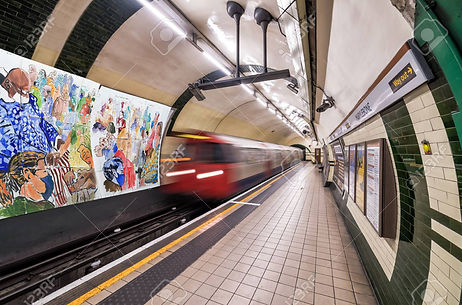
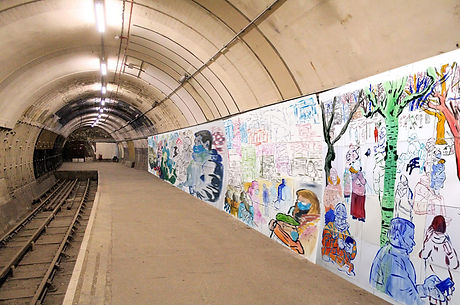
Visual studies for a possible exhibition inside the London Underground stations with my “Wall'' series of paintings. Possible changes would have to be made to the work itself in terms of presentation format since they originally are made on paper, a material that would probably not suit this specific location’s requisites.
References
Martin, A (2012) Undergroun Overground. London: Profile Books LTD
Coverley, M. (2006) Psycogeography. Herts: Oldcastel books
Glaeser, E. (2012) Triumph of the City. London: Penguin Books
Judah, B. (2016) This is London. London: Picador
Greene, J. (2014) Moral Tribes. London: Penguin Books
Taylor, C. (2011) Londoners. London: Granta Publications
Sinclair, I. (2017) The Last London. London: Oneworld Publications
Mason, M. (2011) Walk the Lines. London: Arrow Books